 Edgio
End-of-session journal
After every session, you write what you went through in free-form notes. An AI writing assistant helps you put into words what you can't quite express — because a journal you don't fill in is worth nothing.
The trading journal that tracks the human side first — discipline, mood, adherence to the plan — then cross-references these notes with your results.
A journal that only collects statistics describes a symptom. It never says why.
Edgio rates the human first, then cross-references those ratings with your results: that is behavioural analysis for trading.
You don't fix a curve. You fix a behaviour — and the curve follows.
Your plan and your rules stay in front of you, and a pre-session checklist frames your routine. Nothing is improvised once the session starts.
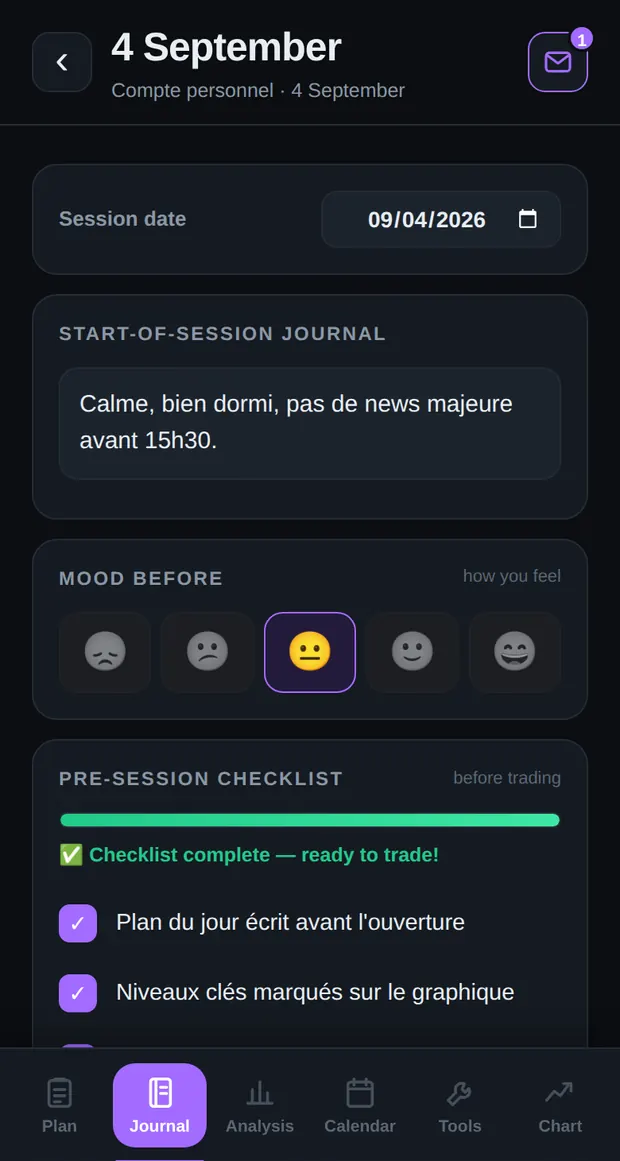
You tick your rules, set your mood, and rate yourself on three axes. For the rest, an AI writing assistant helps you put your session into words.
The Analysis page sets your ratings against your results: the rule that costs you the most, and the axis where you have the most to gain.
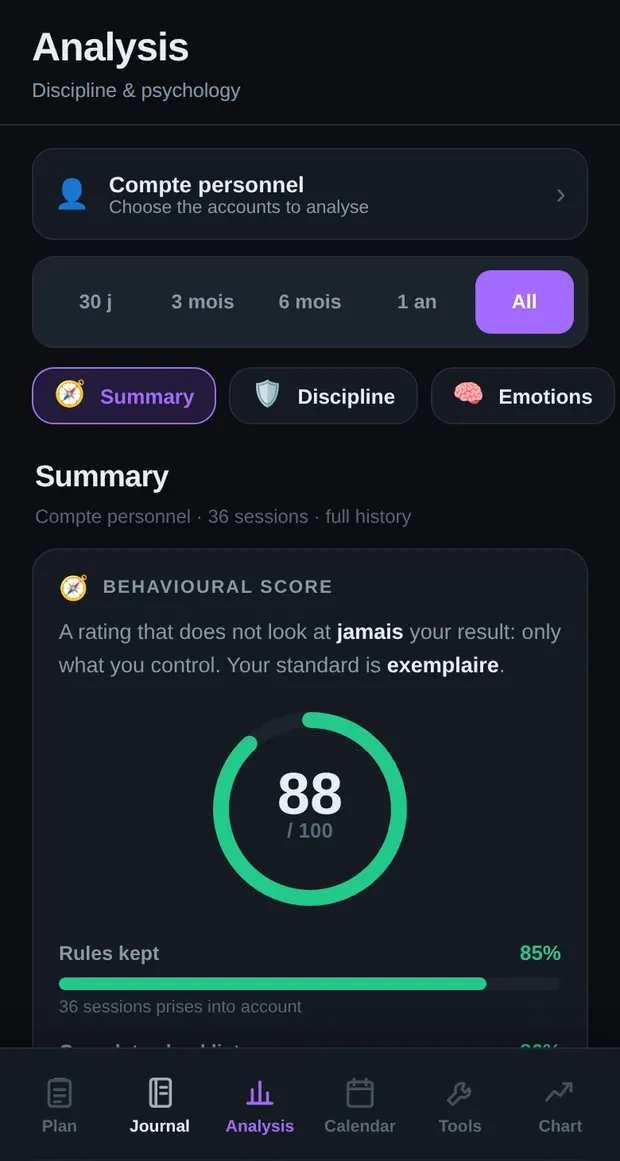
The page where the promise becomes concrete: your discipline and your psychology, set against your hard numbers.
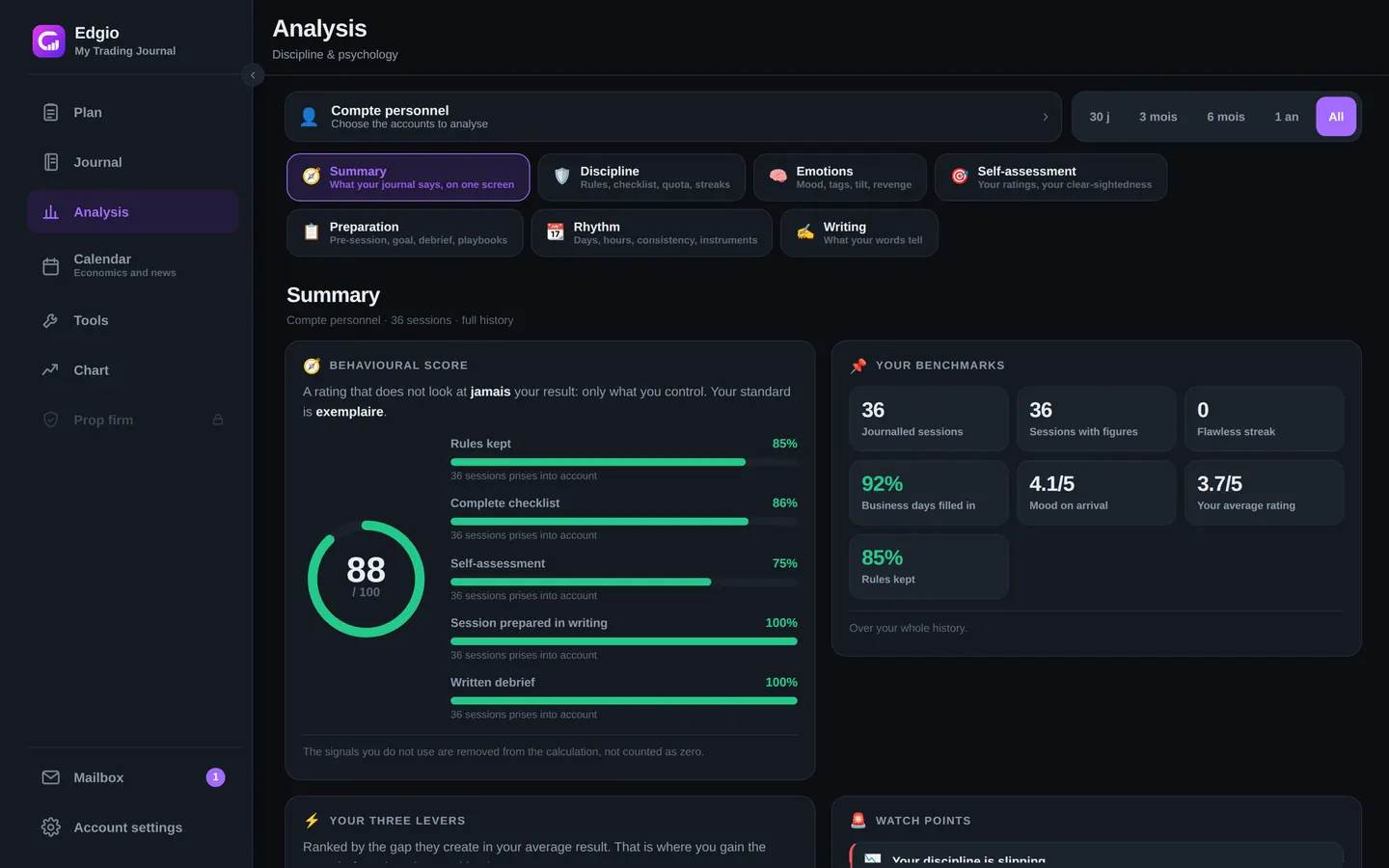
Summary, discipline, emotions, self-assessment, preparation, rhythm, writing: your session gets reviewed from seven angles, and each one asks the same question — what makes the difference, for you?
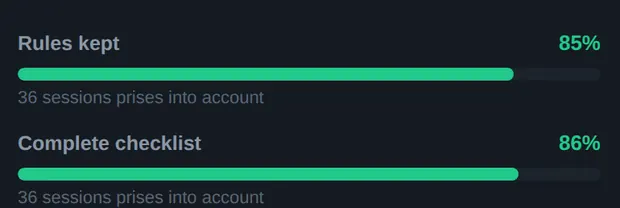
A score out of 100 calculated solely on what you control: rules followed, checklist, self-assessment, preparation, written debrief. You can lose money and still have exemplary conduct — that's exactly what this score can show. Signals you don't use are excluded from the calculation, not counted as zero.
Among your personal rules, Edgio identifies the one whose breach weighs heaviest on your sessions — and puts a number on the gap.
Your result compared according to your mood before the session and according to the tags you apply (“disciplined”, “impulsive”). Emotion stops being a vague feeling: it becomes data.
Across the three axes you rate yourself on — execution, sticking to the plan, emotional control — Edgio points to the one that gets your lowest marks. That is where you have the most to gain, before you even change strategy.
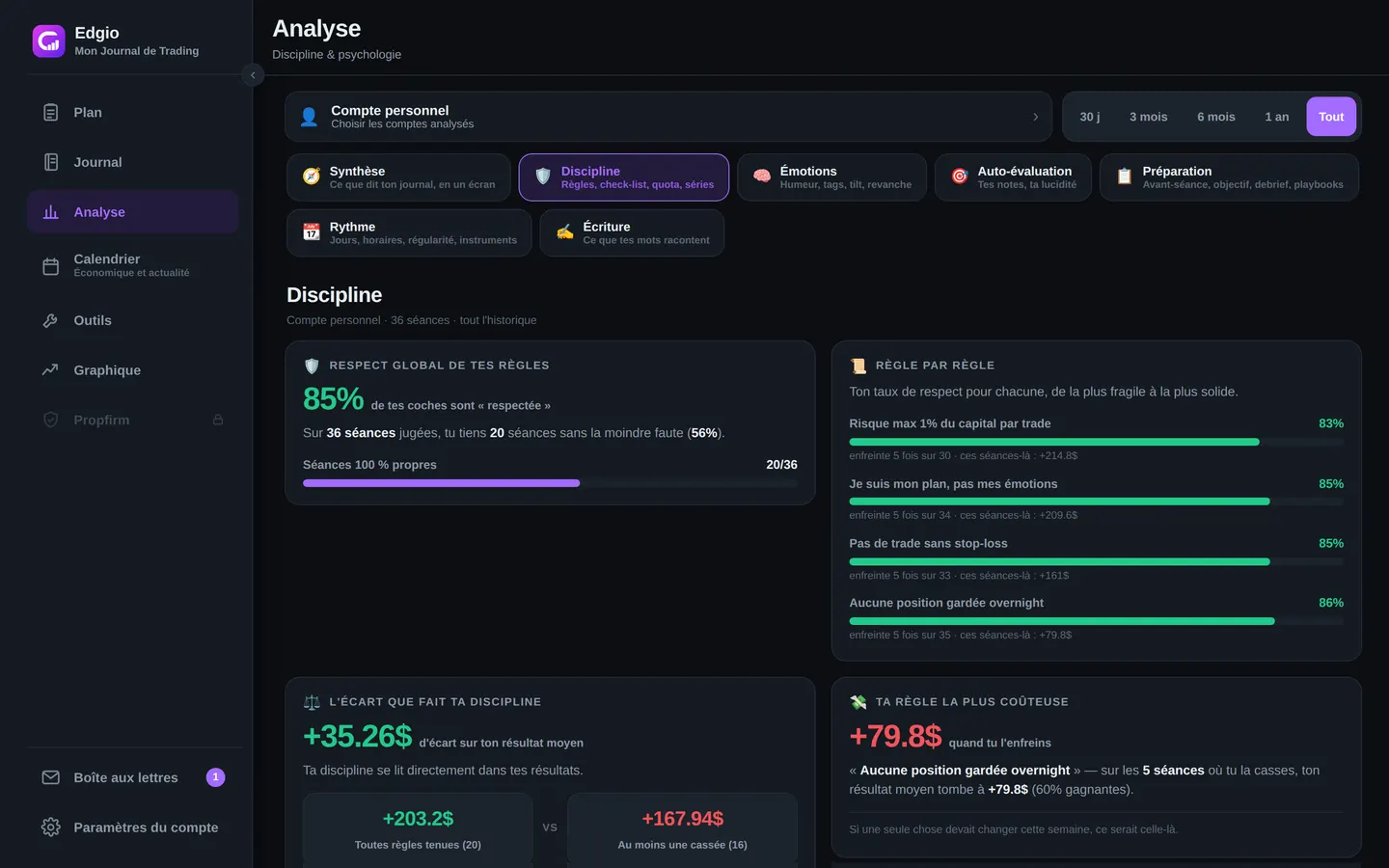
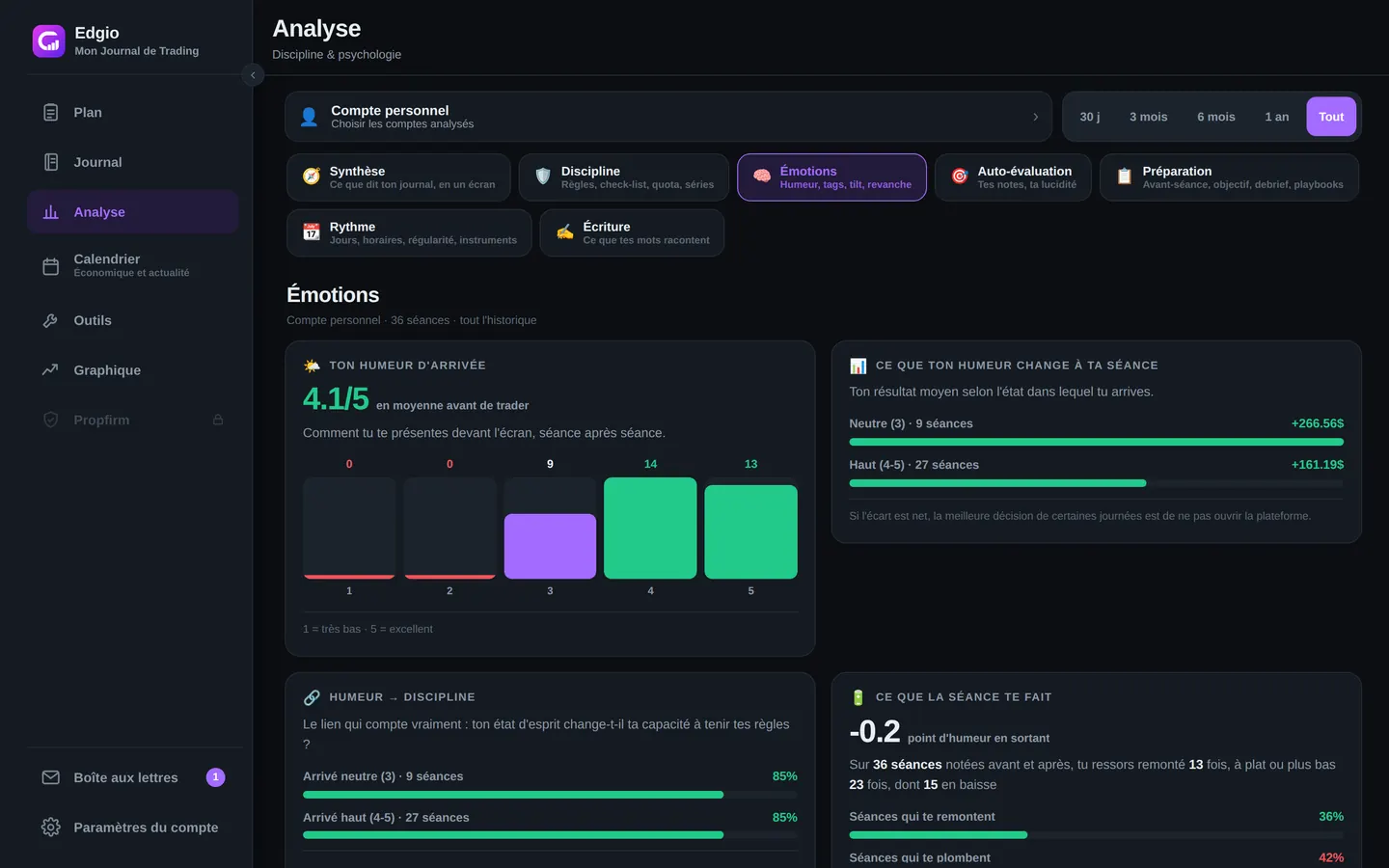
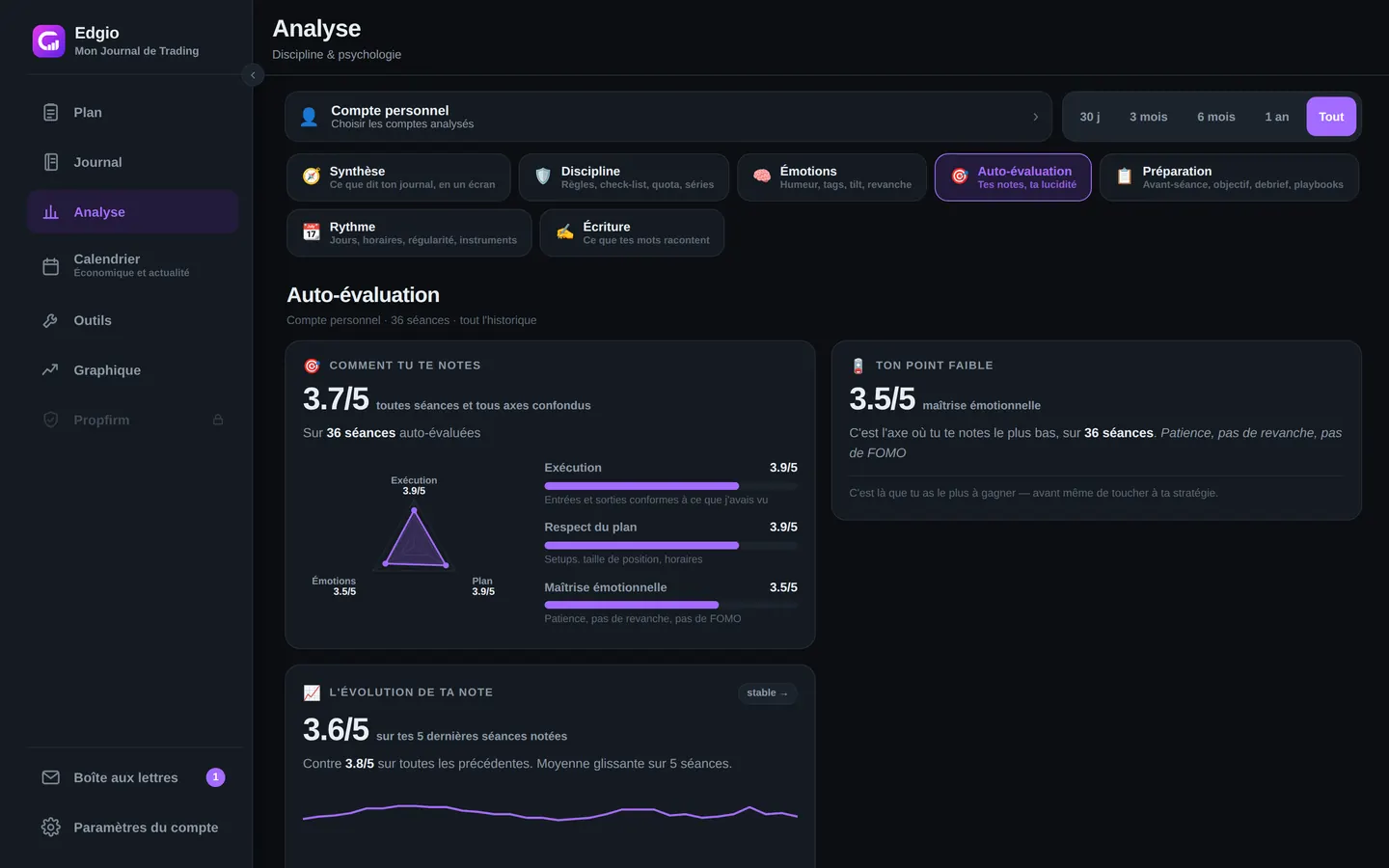
Everything that feeds the behavioural analysis — and nothing that doesn't help you understand what causes your performance.
After every session, you write what you went through in free-form notes. An AI writing assistant helps you put into words what you can't quite express — because a journal you don't fill in is worth nothing.
You rate yourself on three behavioural axes — execution discipline, sticking to the plan, emotional control. Not on your result: on the way you traded.
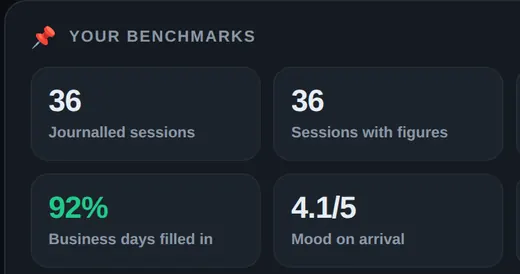
Your mood before and after the session. Two gestures that are enough, over time, to surface the correlation between your state of mind and your results.
You define your own trading rules — “no more than 2 consecutive losses”, “stop loss every time”, “no trade after 11:30” — and you tick off, session after session, whether they were kept.
Your routine before you trade, customisable. Edgio then measures the gap in results between the sessions where you completed it and the ones where you rushed it.
Tie each session to a setup and follow the statistics specific to each one. The answer to the only question that matters: which of my setups still deserves my time in session?
A single screen holds the session in the order you experience it: opening journal, pre-session mood, checklist you tick off, goals for the day, then your rules noted one by one. Nothing to open elsewhere.
Instrument, direction, hours, price, result: the trade is logged in a few fields. And above all, you attach emotional tags to it — "FOMO", "discipline", "revenge trade", "over-trading" — and a note. This is the material the analysis reviews afterward.
The blank page is the top reason people stop keeping a journal. Hence an automatic summary of the session — result, mood, rules kept or broken, checklist — and templates to insert: full debrief, tough session, good session. You start from a base, then fill in what the machine can't know.
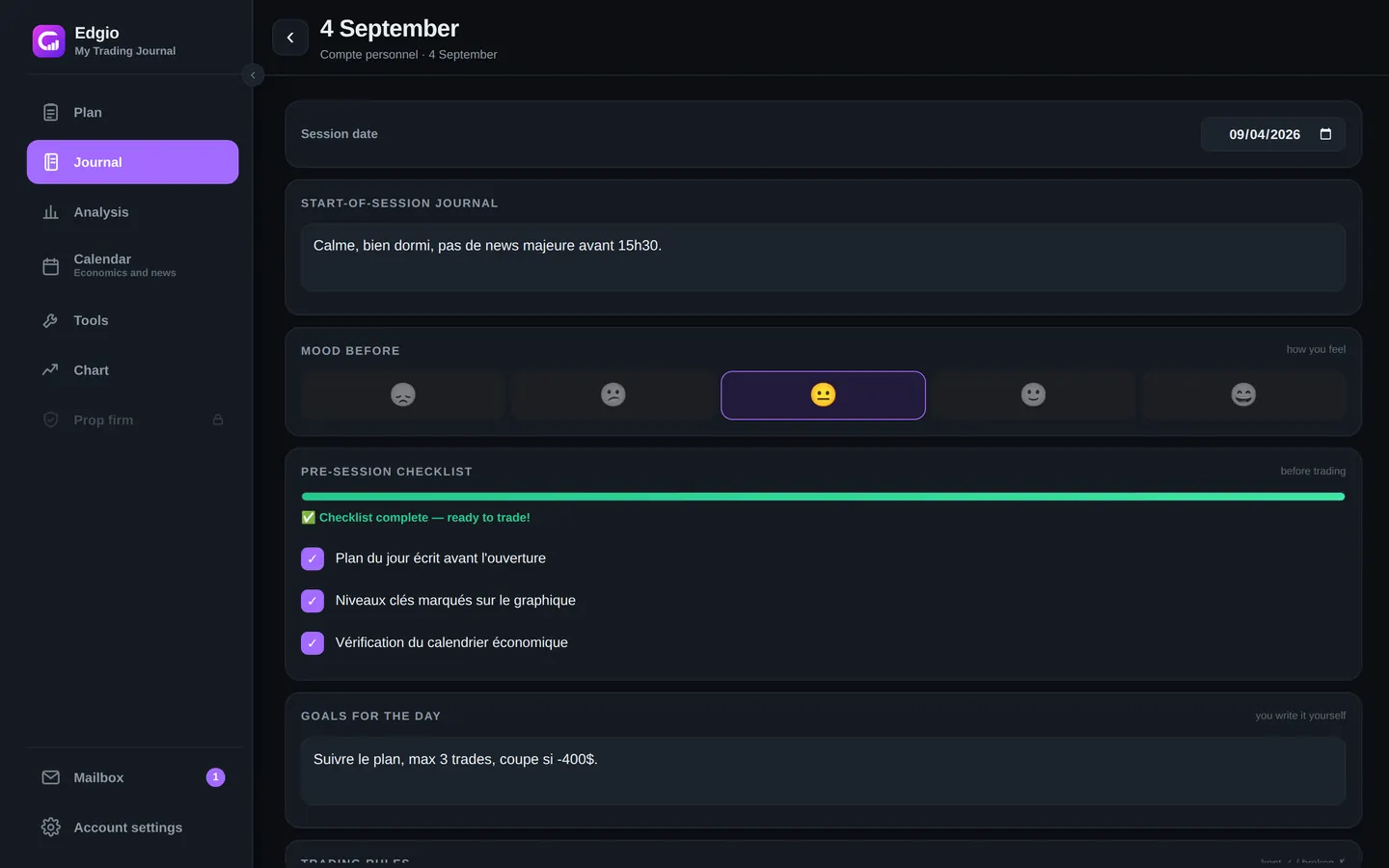
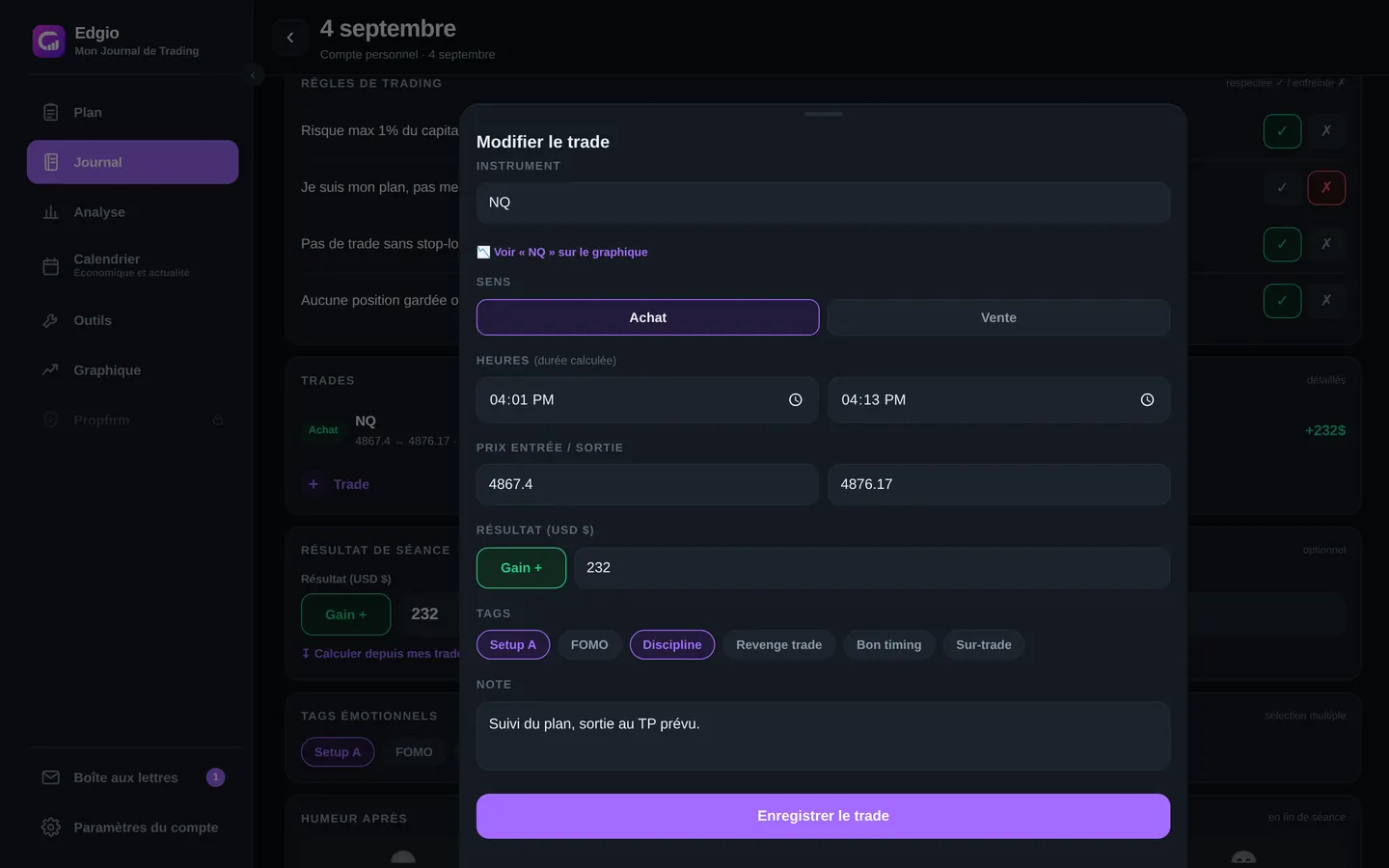
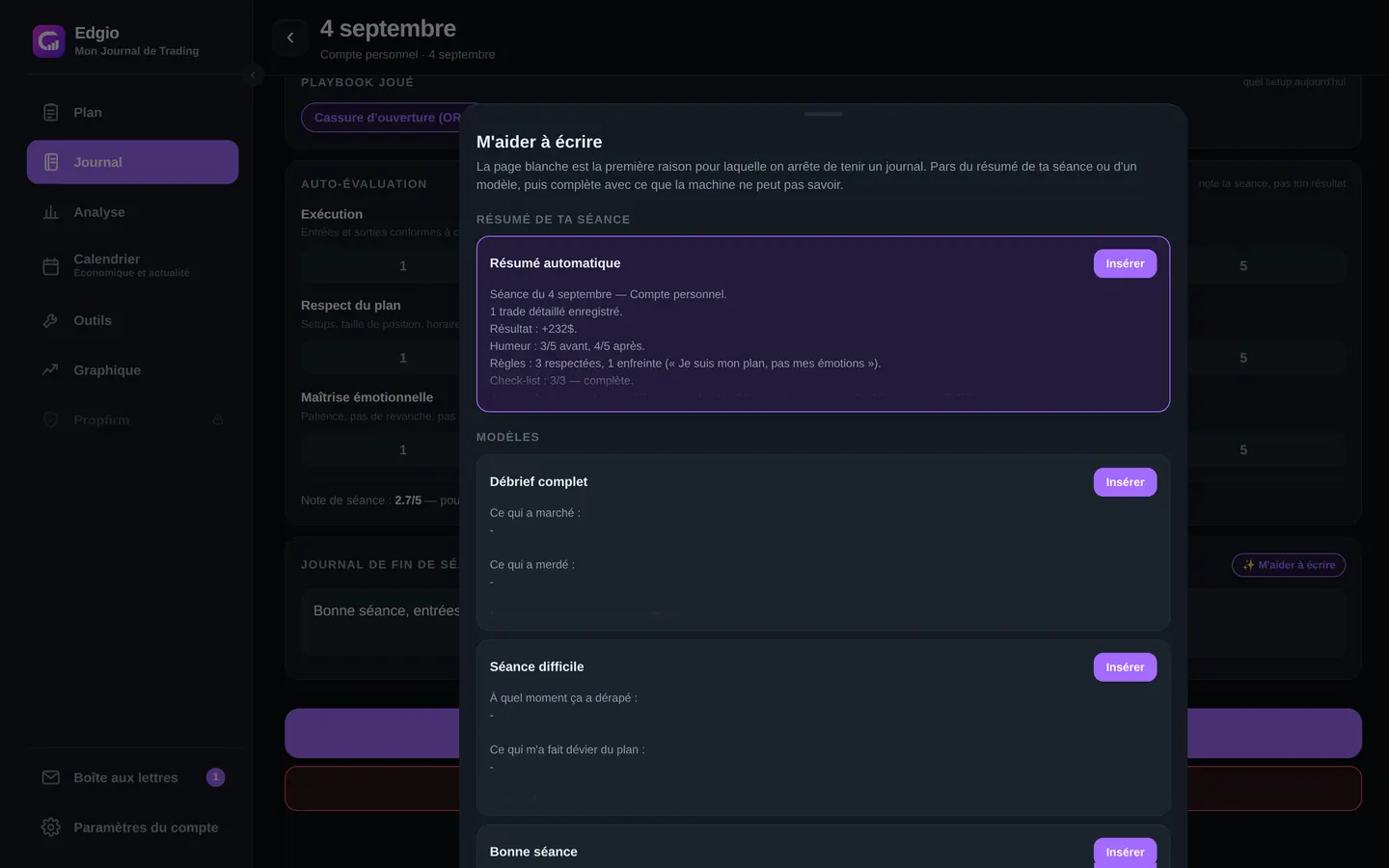
The rest of what a trading journal has to do — done properly, without making a selling point of it.
Live account, prop firm, demo: each account has its own journal, with an all-accounts combined view. On desktop, the dashboard is customised with widgets.
Per account and combined, with a winning / losing colour code day by day. A month of sessions reads at a glance: the green days, the red days, the days you didn't trade.
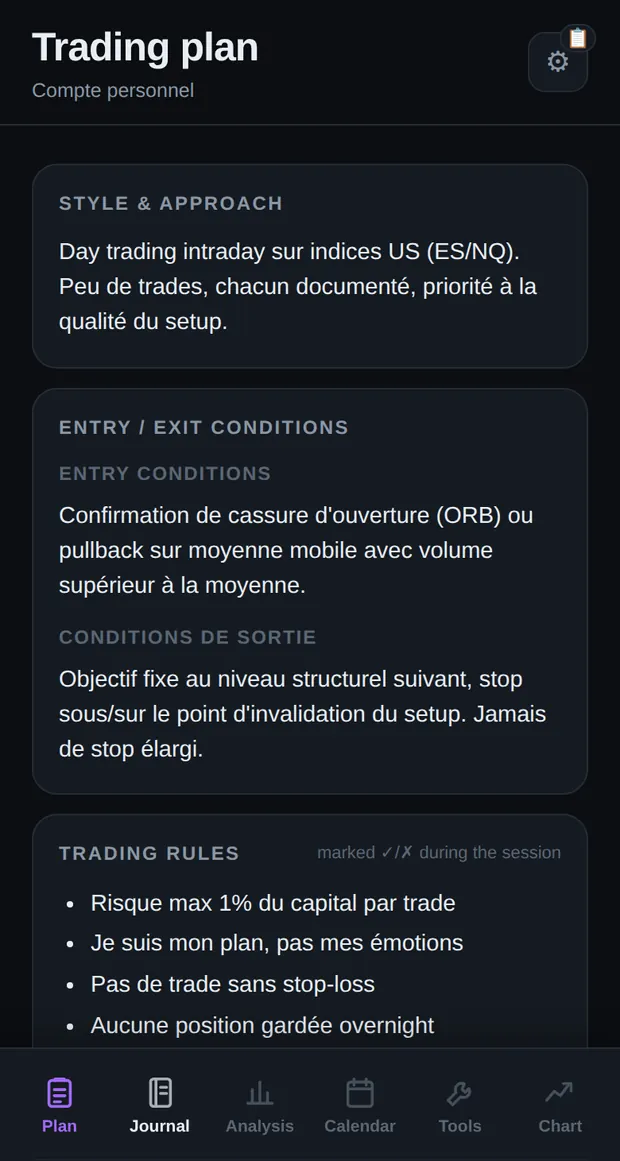
Your strategy and rules right in front of you: style and approach, entry and exit conditions, rules noted during the session, pre-session checklist, playbooks, risk management. Each category is edited separately — and you leave blank what you don't use.
The macro calendar of high-impact releases and a market news feed, built into the app. Enough to prepare your session without switching tabs.
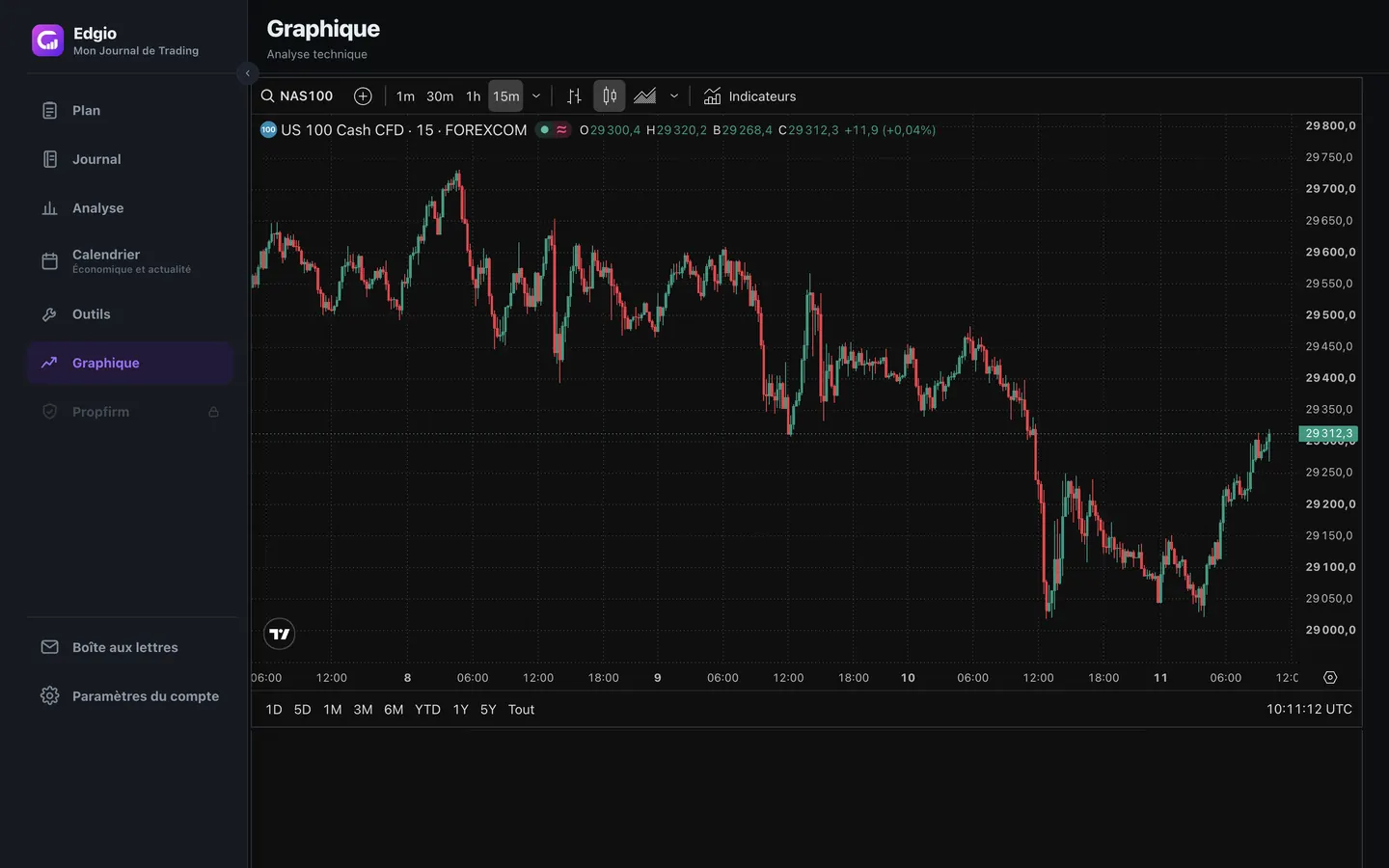
A trading chart right inside the app, to annotate a session or review a setup without leaving your journal.
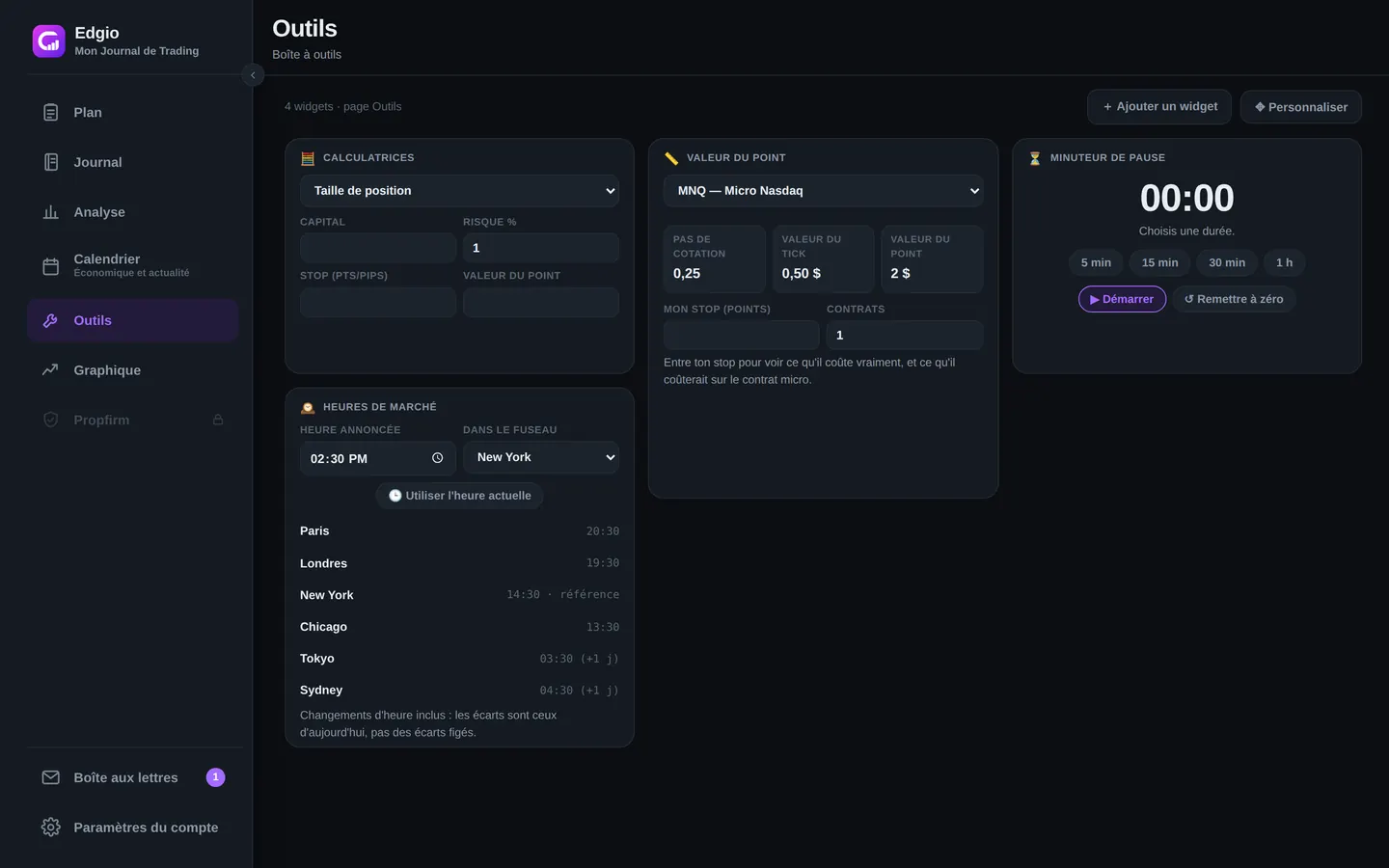
Contract spec, session timer, clocks for the world's marketplaces (Sydney, Tokyo, London, New York) and trading calculators. Everything you usually keep across ten tabs, gathered in the app.
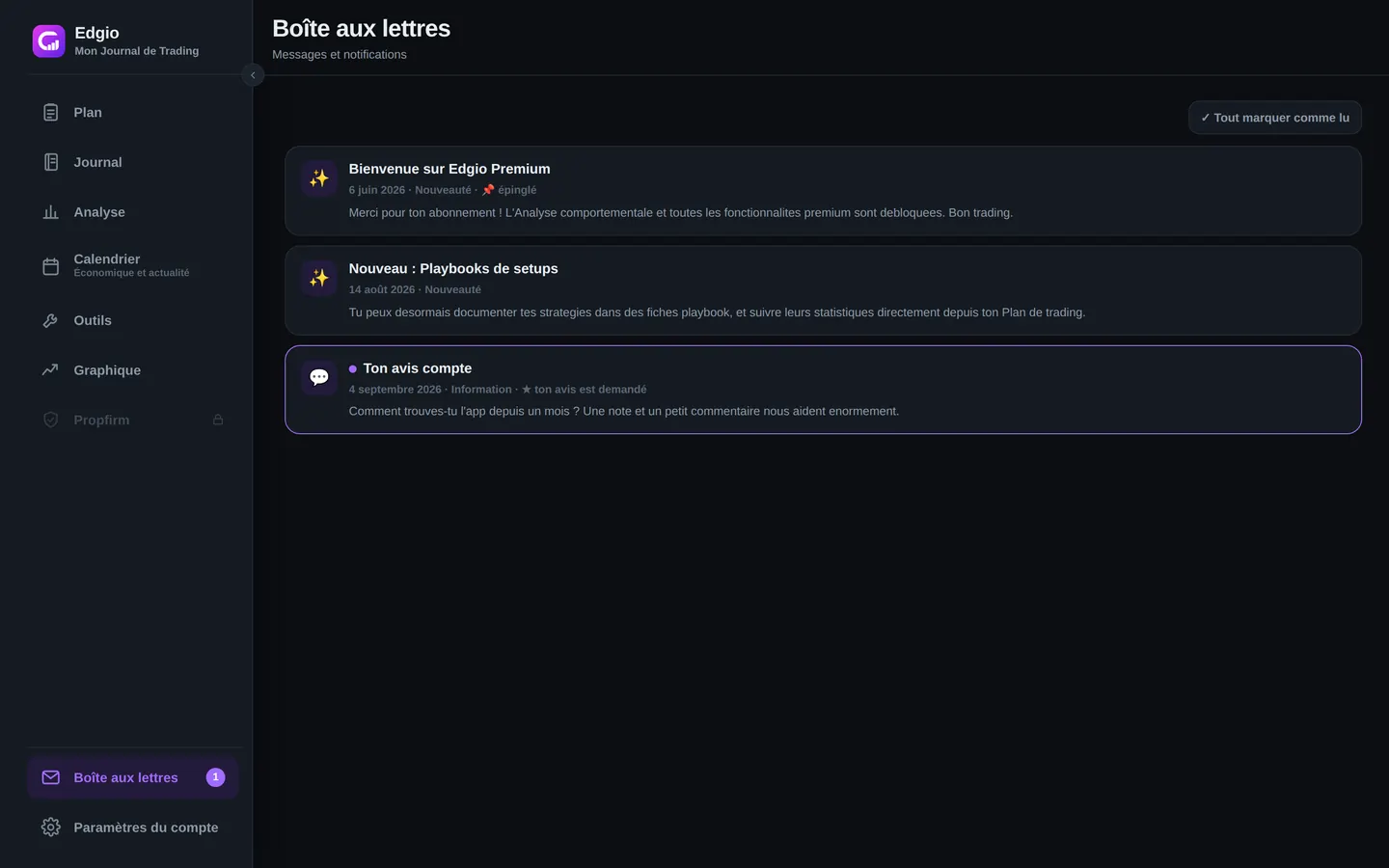
Product news arrives where you work, not in a newsletter: every feature shipped is announced in your mailbox, and that is also where we ask what you think.
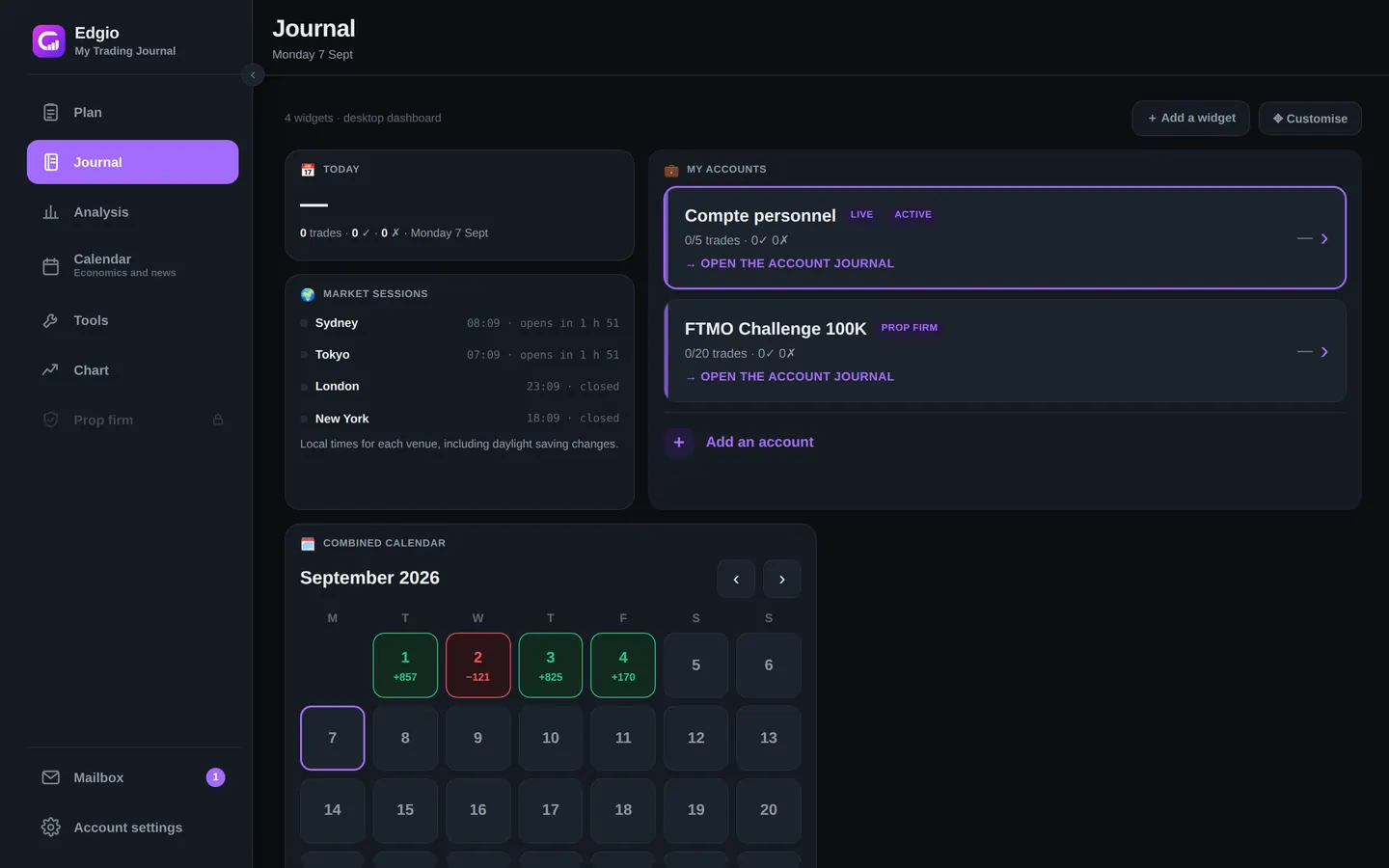
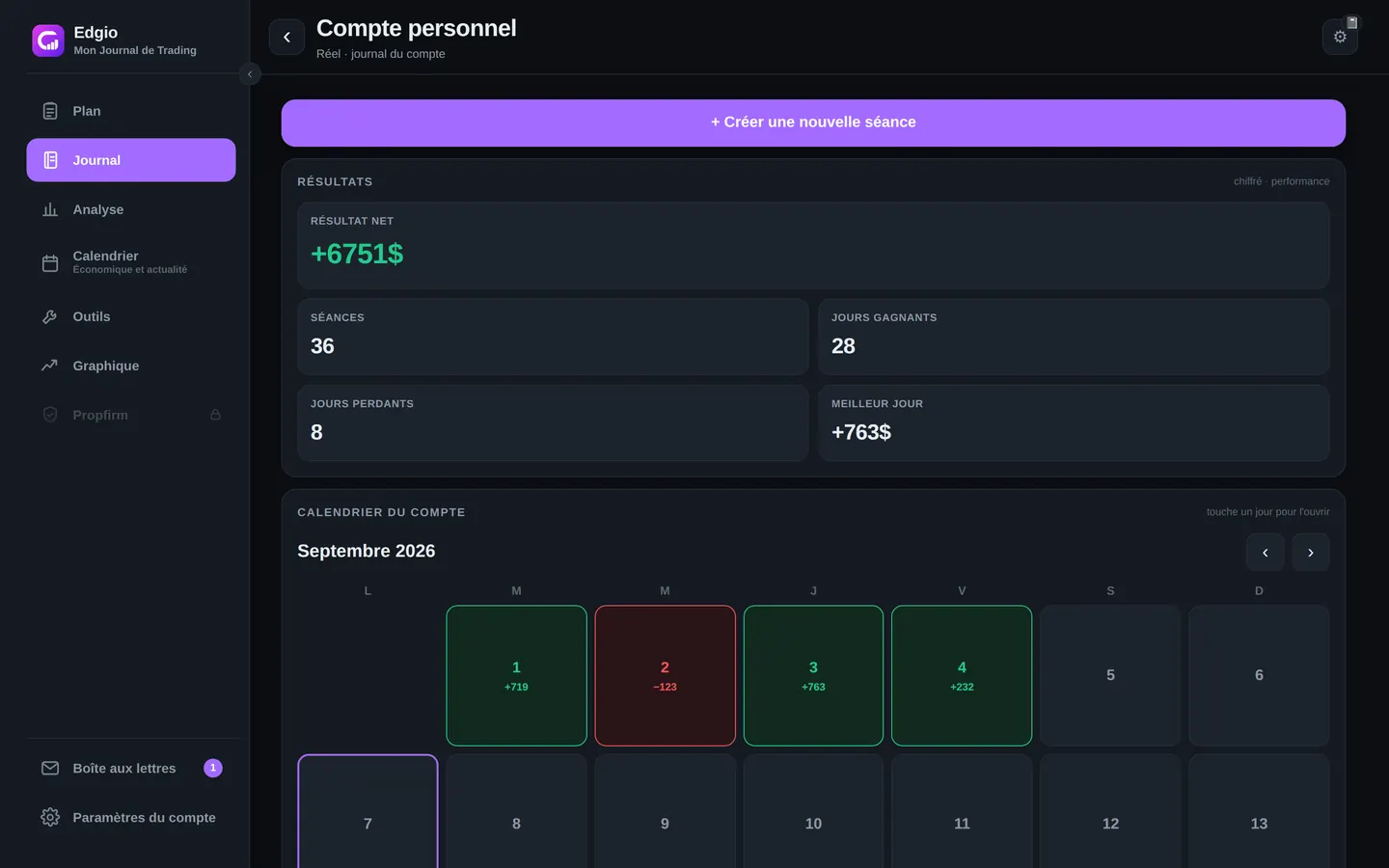
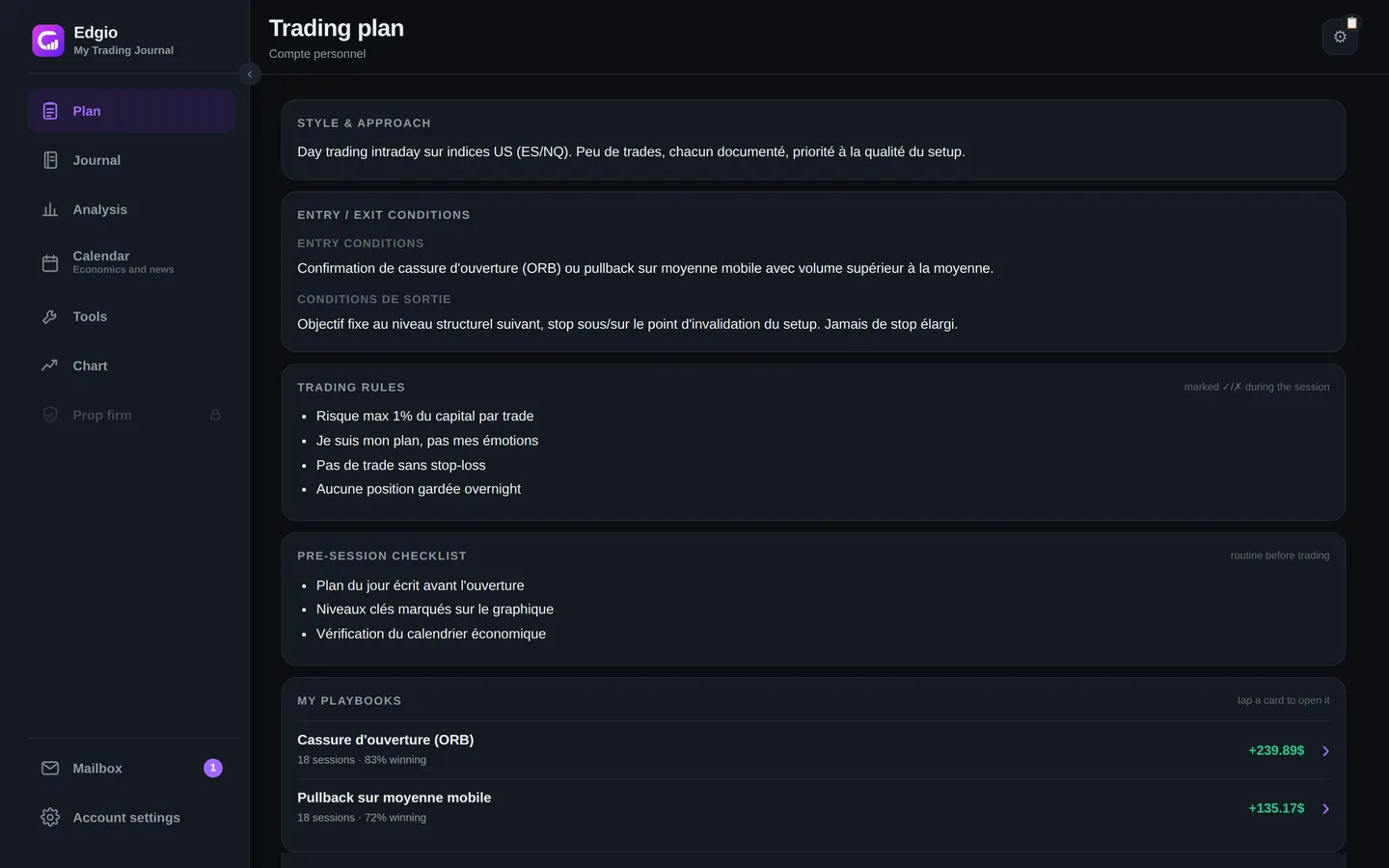
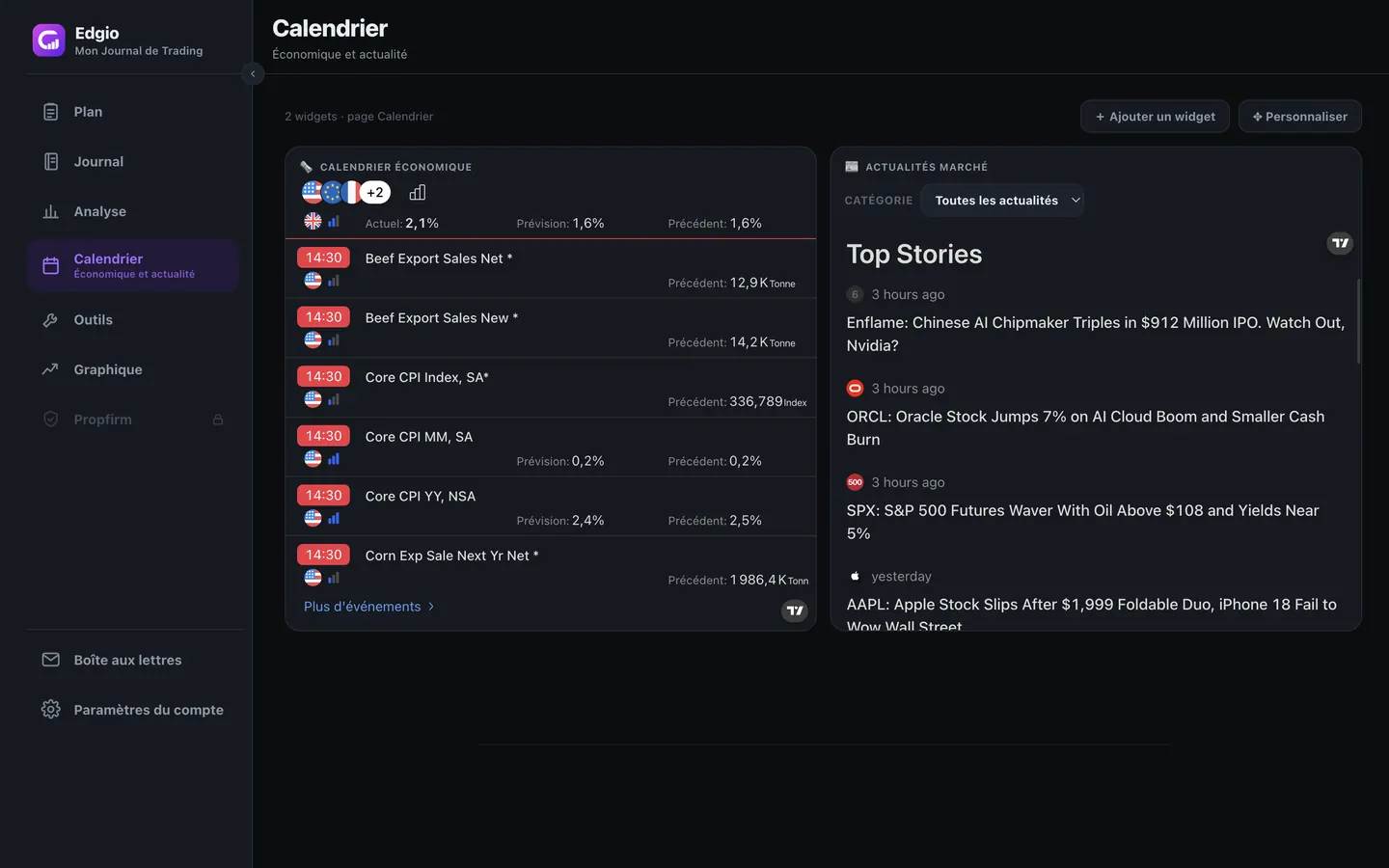
Scalping, day trading, swing: a journal you're forced to use is a journal you abandon. The account, the home screen, the language, and even the app's color adapt to you, not the other way around.
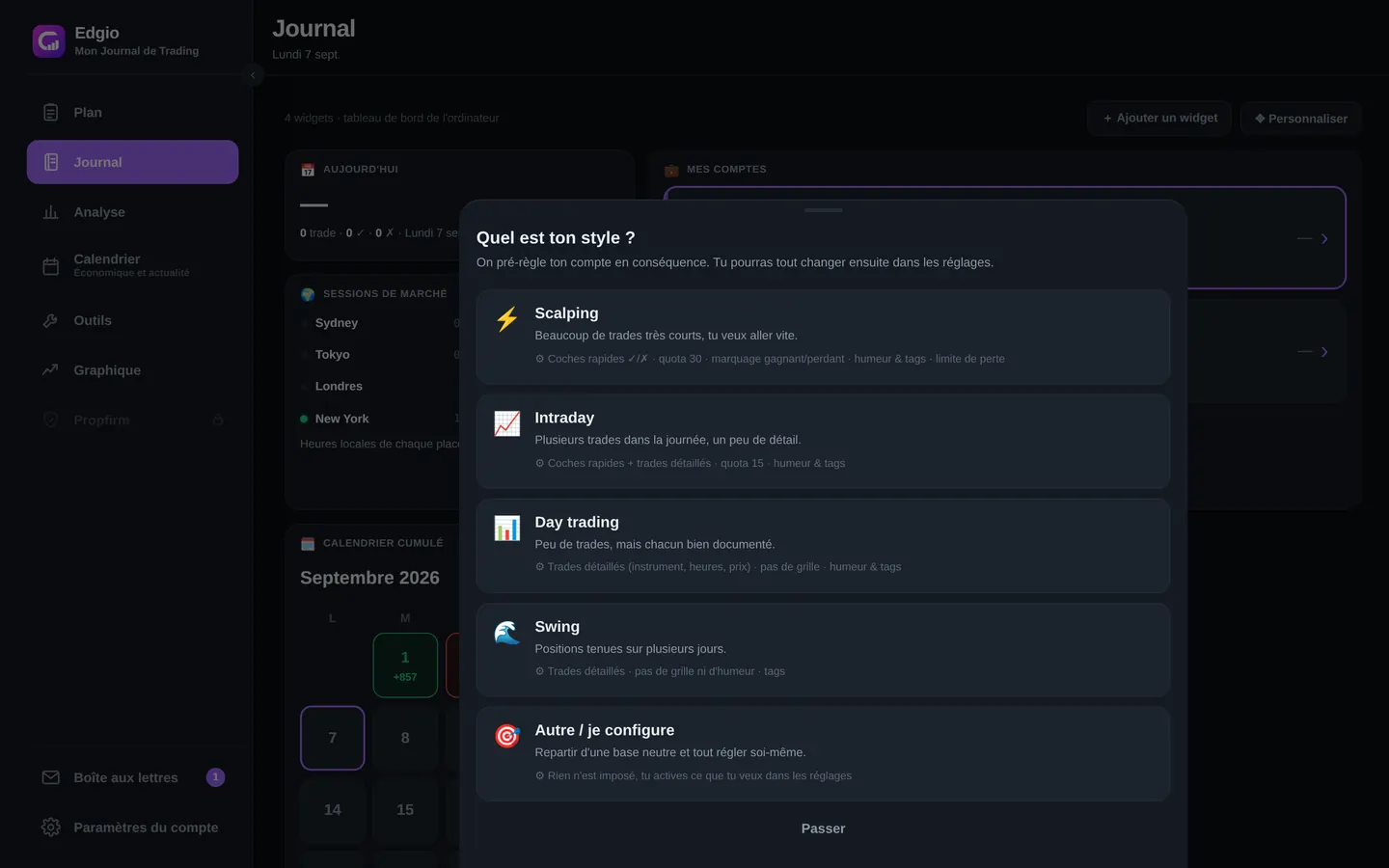
Scalping, intraday, day trading, swing — or "I'll set it up myself." You choose, and Edgio pre-configures your account accordingly: checkbox grid or detailed trades, quota, mood, tags, loss limit. Every option stays adjustable afterward, one by one.
At 20 or 30 trades a day, writing after each one breaks your rhythm. Hence an ultra-fast grid: one tap per winning or losing trade, live counter and progress. The daily quota is set session by session.
Account type (live, prop firm, demo), result unit — dollars, euros, pounds, points, or pips —, detailed trades, quota, loss limit, mood, tags: everything is optional and unfolds category by category.
On computer, the dashboard is a grid of widgets that you add, move, and resize: Today, My accounts, Cumulative calendar, Latest sessions, Market sessions, Notes… You keep only the ones that speak to you. The Tools and Calendar pages work the same way.
The app switches entirely with one setting to French, English, Spanish, Italian, or German. Light, dark, or system theme, and ten accent colors. Small details — except when you spend an hour a day in a tool.
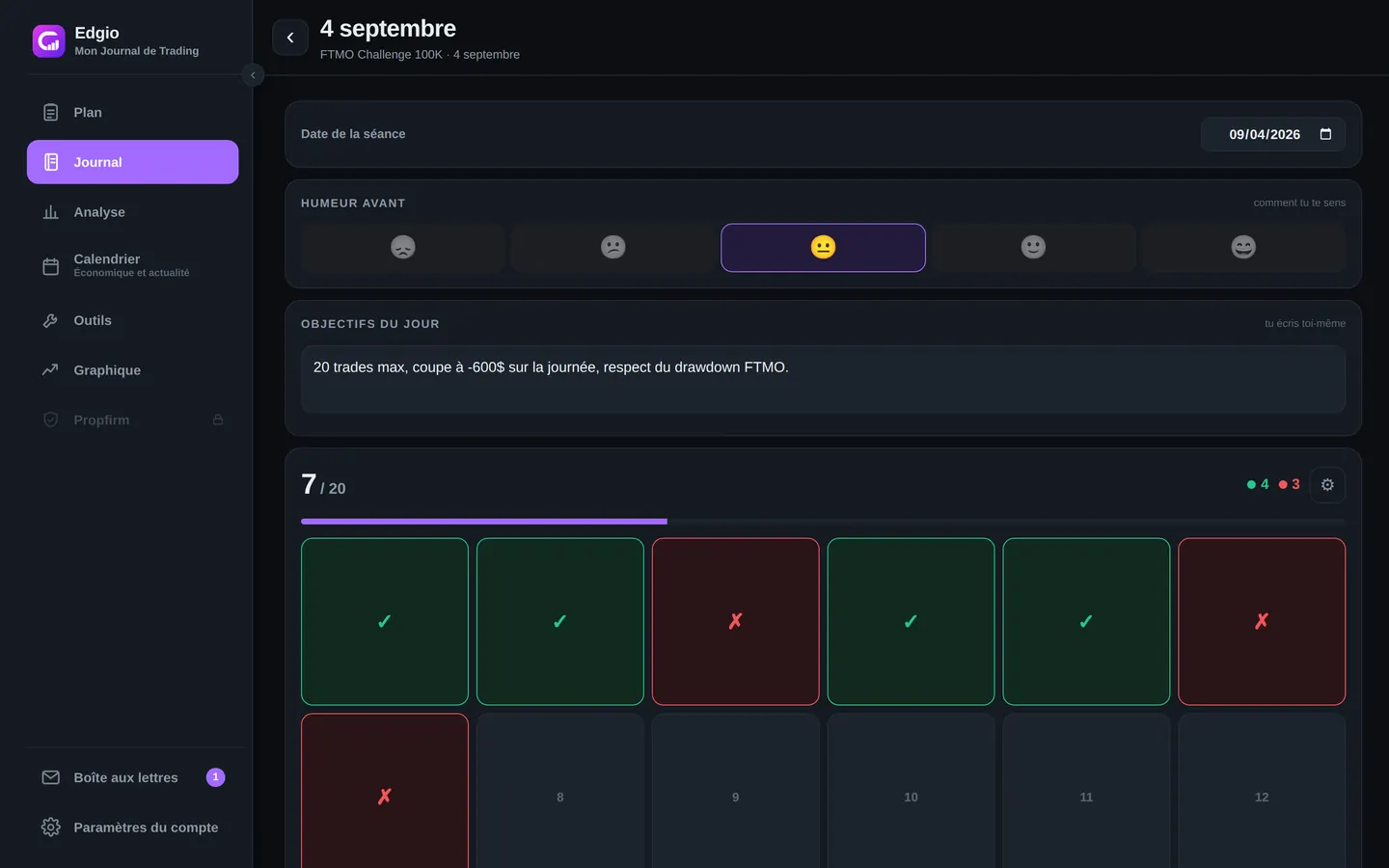
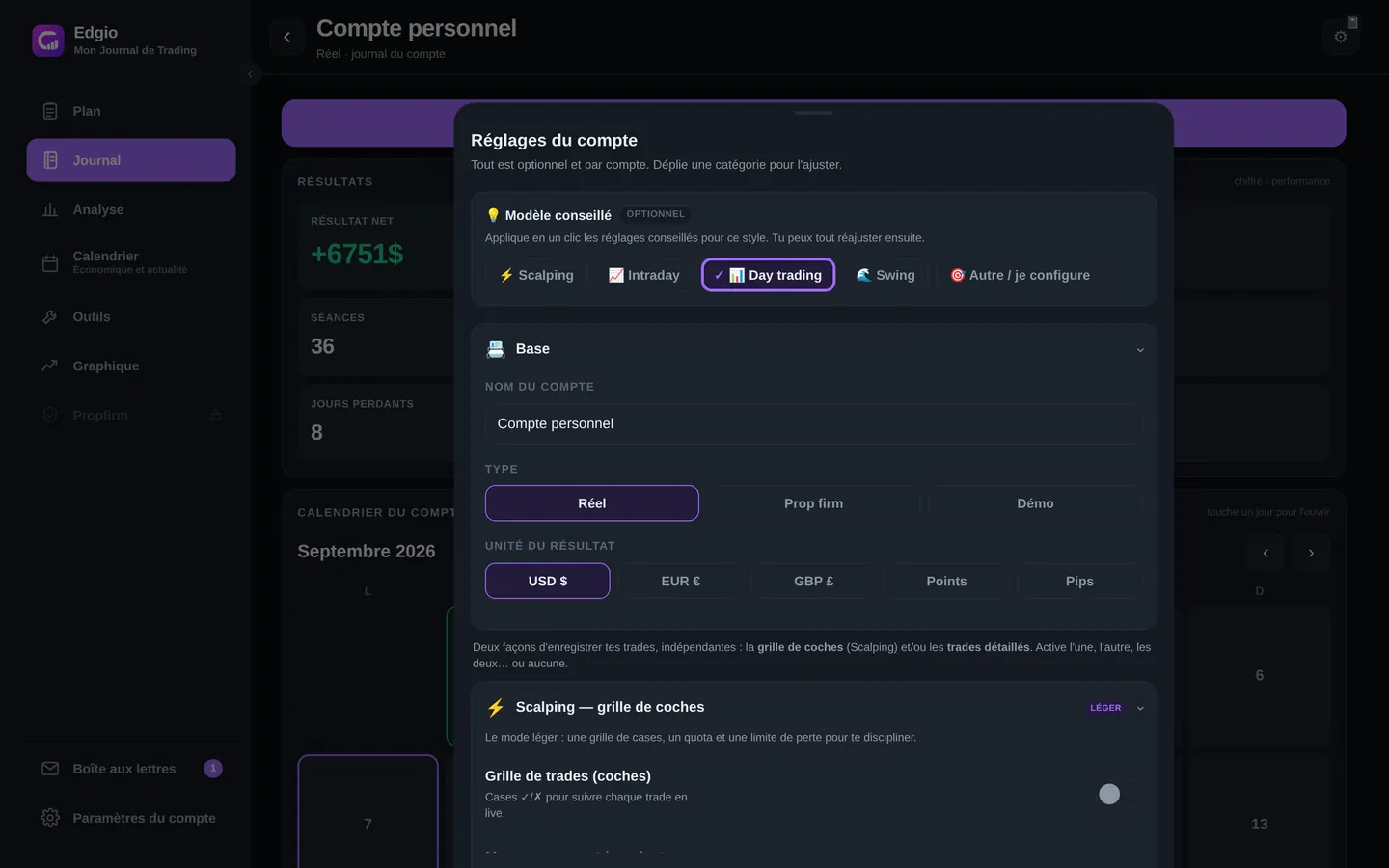
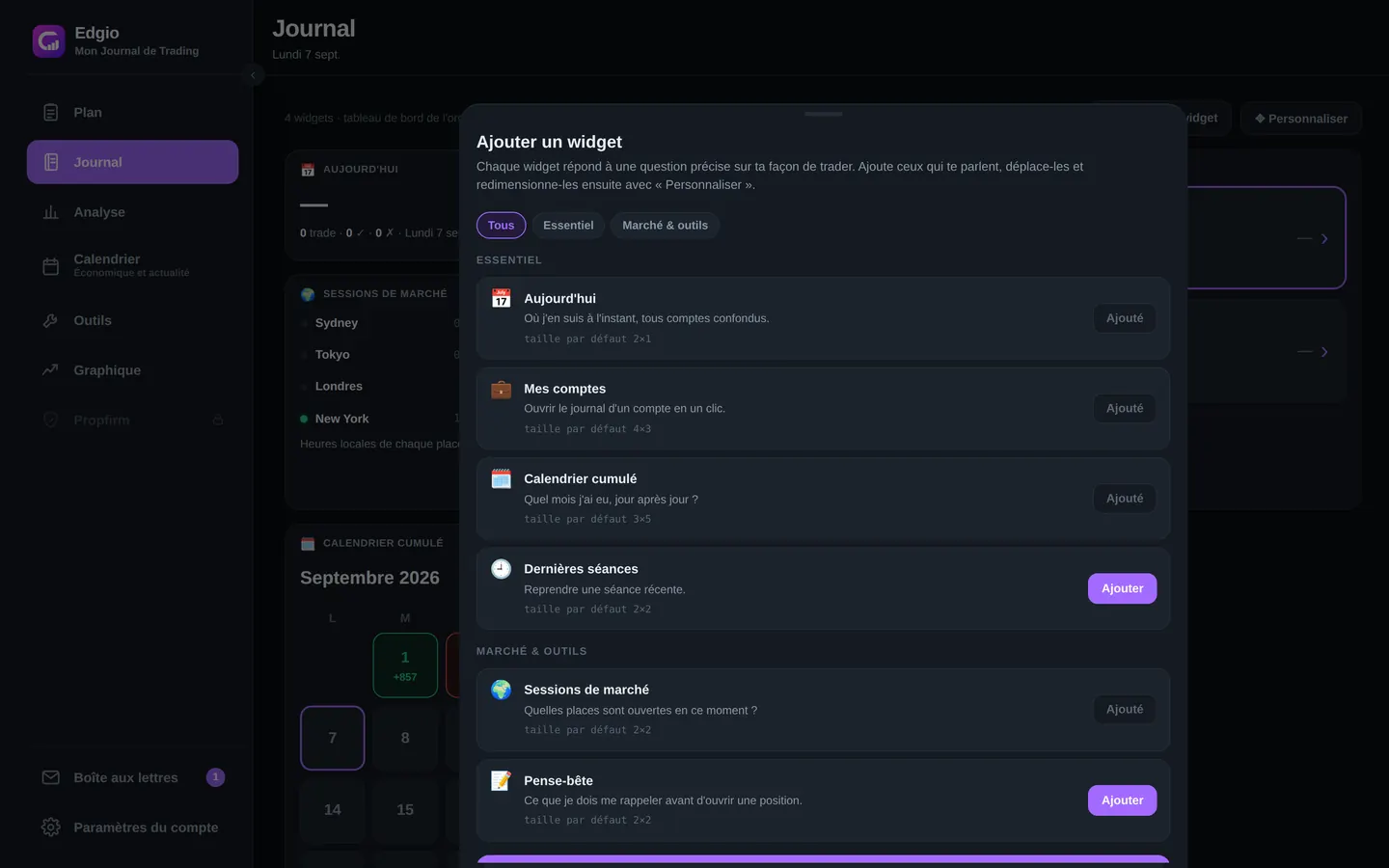
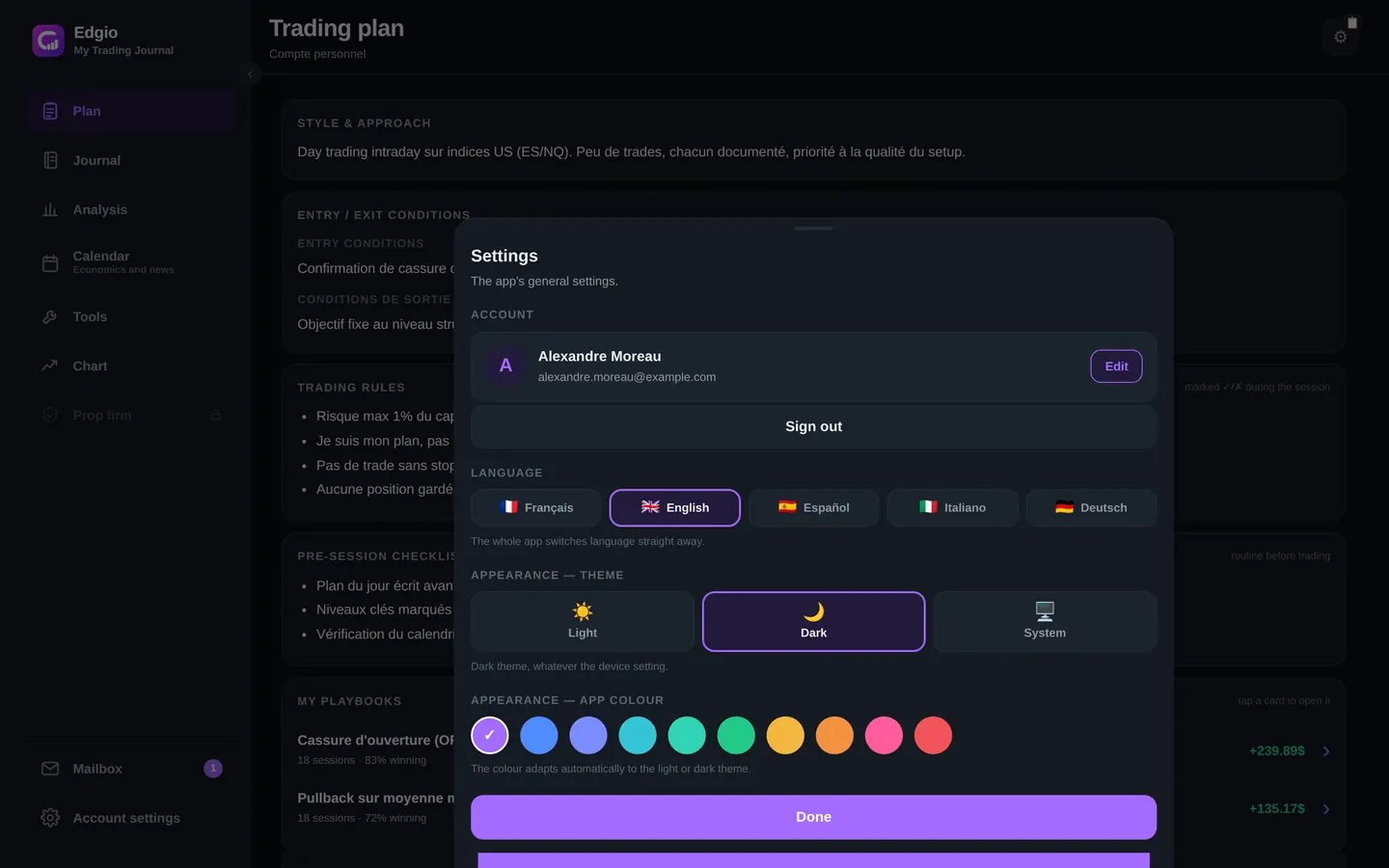
One app, two uses: you log your session on mobile, you analyse it calmly on a big screen.
An interface that adapts to your screen: bottom navigation bar on mobile, full sidebar and widget-based dashboard on desktop.
Installable on your home screen, iOS and Android, straight from your browser — no store, no download. How to install it →
What's in progress is presented for what it is — not sold as already done.
A pre-session briefing designed for prop firm challenges. The page already exists in the app, but it's locked: it's not yet an available feature.
New features roll out regularly and are announced in your inbox once they're live — never before.
A classic journal records numbers: P&L, win rate, average R. Edgio starts from the other end: you rate the trader first — execution discipline, sticking to the plan, emotional control, mood before and after the session, personal rules kept or broken — and the app then cross-references those ratings with your results to show what actually drives your performance. The numbers are still there; they just stop being the only thing in the journal.
It's the Analysis page. It sets your discipline and psychology ratings against your hard numbers and draws concrete conclusions: the gap in results between sessions where you keep every rule and sessions where you break at least one, the rule that costs you the most when you break it, what your checklist does, the impact of your mood and your tags, and your weak spot among the three axes you rate.
That's the principle — but Edgio keeps it short. Ticking your rules, setting your mood and rating yourself on three axes takes a few seconds. For the free-form notes, an AI writing assistant helps you put words to what you went through when the blank page stops you. A journal you don't fill in is worth nothing: everything is designed so that you fill it in.
Yes. Live account, prop firm challenge, demo: each account has its own journal, calendar and statistics, and an all-accounts combined view pulls them together. On desktop, you compose your dashboard by adding, moving and resizing widgets.
Edgio is a web app you install as a PWA: nothing to download from the App Store or Play Store. On iPhone, open app.edgio.fr in Safari, tap Share then “Add to Home Screen”. On Android (Chrome), open app.edgio.fr and tap “Install app”. The icon lands on your home screen and the app opens full screen.
Not yet. The Prop Firm module — a pre-session briefing designed specifically for prop firm challenges — is visible in the app but locked. It is an upcoming feature, not a shipped one. In the meantime you can track your challenge as a full account, with its journal, its plan and its rules.
Yes, you can start for free, no credit card. A premium plan additionally unlocks behavioural analysis and the other advanced features.
Each user can only reach their own data and traffic is encrypted (HTTPS). Edgio does not connect to your broker and never sees your money. Details in our privacy policy.
No. Edgio is a journalling, self-assessment and behavioural analysis tool, not an investment adviser. No signals, no promise of profit. Trading carries a risk of losing capital; your decisions remain yours.
Create your account and track your discipline, mood, and rules starting with your next session.
Start for free